
Stay calm. Plan accordingly. And tune in to David Booth with Cameron Passmore on The Rational Reminder podcast.
Every now and then, I hear a conversation about investing that cuts through all the usual noise.
No prediction about what markets will do next. No exciting new fund or fashionable idea. Just a calm, thoughtful explanation of what 50 years of evidence has taught us - and why the future being uncertain is not a flaw in investing. It’s the whole point.
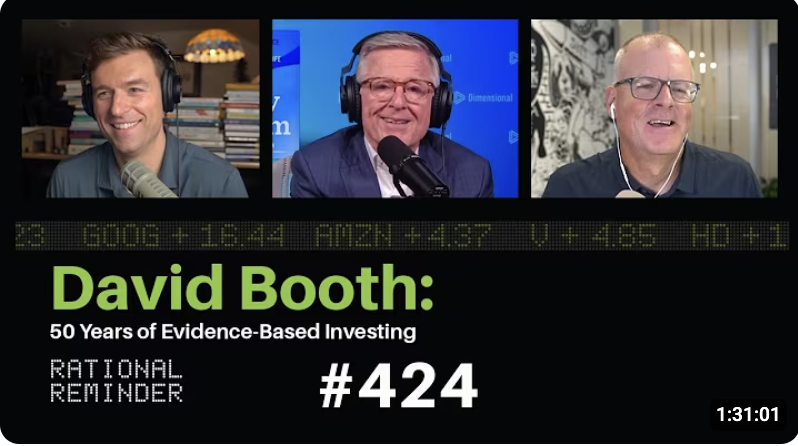
I heard one of those conversations recently when Cameron Passmore interviewed David Booth, co-founder and chairman of one of our trusted fund managers, Dimensional Fund Advisors, on The Rational Reminder Podcast.
You may recognise Cameron’s name as I interviewed him on The Retirement Cafe Podcast a few years ago and I was also a guest on the hugely successful Rational Reminder podcast. I’ve followed his work ever since.
His conversation with David Booth is thoughtful, optimistic and unusually human. I encourage you to listen to it.
The birth of Dimensional - the question that changed everything
Booth explains in the podcast how, early in his career, he found himself wrestling with a deceptively simple question:
"If professional fund managers could not consistently outguess the market, what should investors do instead?“
That question helped shape the next 50 years of his working life.
The answer was not to find a better crystal ball. It was to use evidence, trust the collective power of markets, pay close attention to implementation and build an investment philosophy you can actually live with.
Booth puts it simply: the most important thing about an investment philosophy is having one you can stick with. A strategy can look very clever on paper, but it is no use if fear, excitement or the latest headline causes you to abandon it at precisely the wrong time.
A new winner every year
We all have an opinion about the future - which companies will prosper, which economy will grow fastest, which country will lead the market. The trouble begins when one of those views becomes the foundation of your whole investment portfolio.
Booth championed diversification as a more honest approach, admitting:
“We do not know what comes next. Nobody does.”
This is exemplified by the table below showing the best and worst performing developed market returns over the past 20 years. You will quickly spot that there is no dependable pattern.
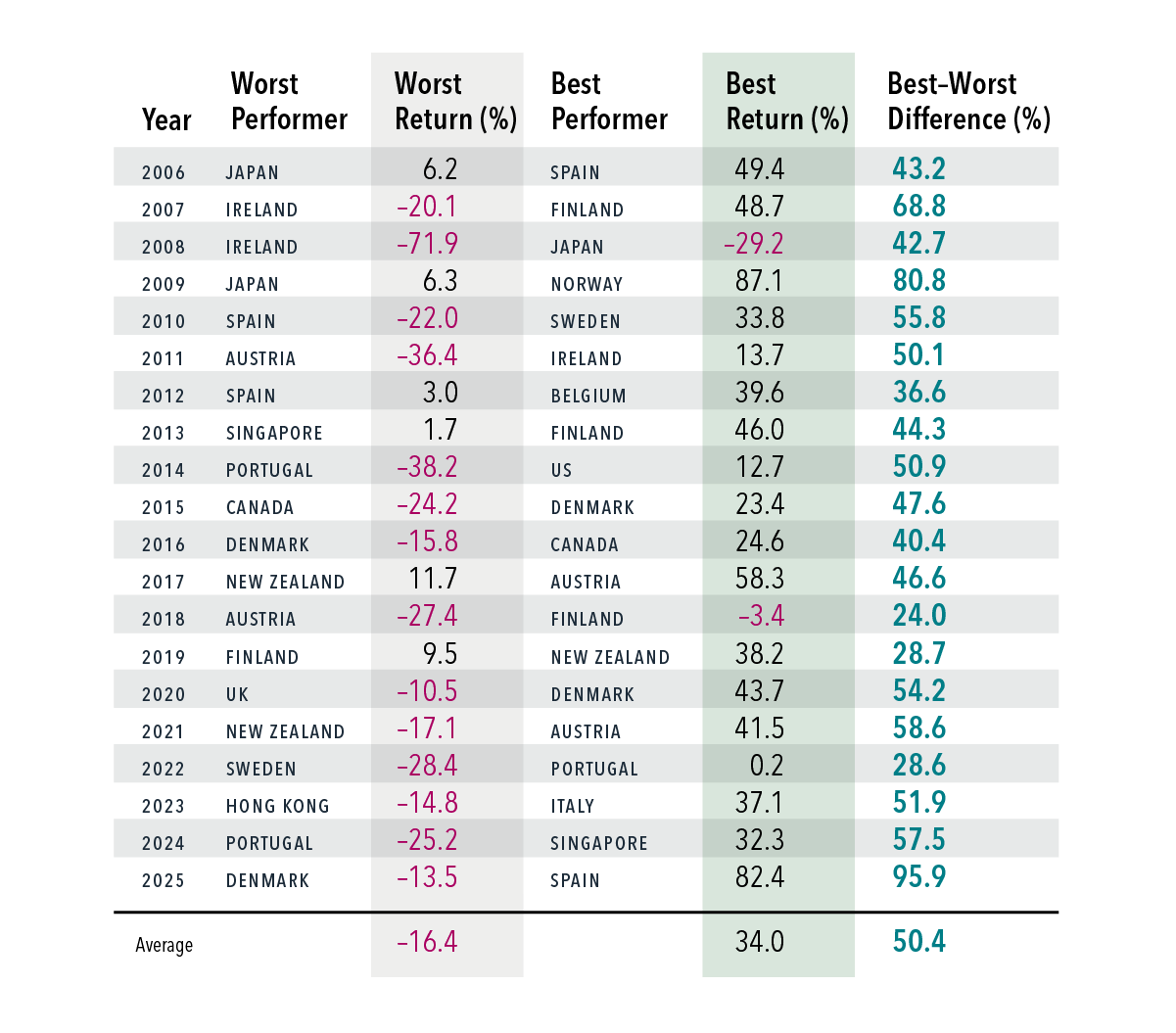
Pick your investment market correctly and you look like a genius. Choose badly and the damage can be considerable. The awkward part is that you must choose before the year begins.
The same portfolio. Four different lives.
The longer historical study below tells the same story in a different way. It compares an investor who owned only their home market with one who held an equal share of 16 markets around the world, measured in the investor's own currency and after local inflation.
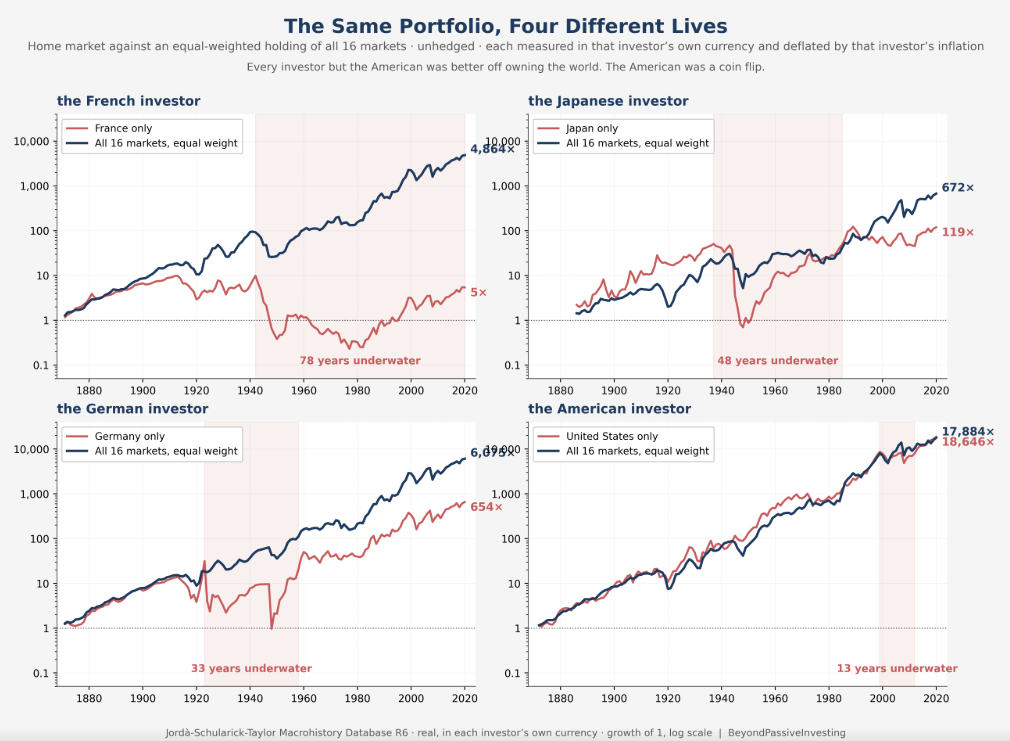
For French, Japanese and German investors, owning shares in the world instead of just their home market changed the experience dramatically. The diversified portfolio finished far ahead and helped avoid extraordinarily long periods below the home market's previous inflation-adjusted peak.
For the American investor, the outcome over the full period was essentially a coin toss.
The lesson is not that America - or any other market - should be avoided. It is that yesterday's winner does not come with a promise for tomorrow.
A portfolio is not a plan
Diversification reduces our dependence on any one prediction. But investments are only part of the picture – money is ultimately there to support the life you want to live.
In the podcast, Booth describes financial planning as a process of trade-offs, flexibility and adaptation. That reflects how we work at MFP: we understand what matters to you, we build a financial plan around it, then create an investment strategy to support it. And as life changes, your plan changes with it.
Understanding uncertainty doesn't make us immune to the fear, urgency or discomfort we can feel when markets fall.
David Booth recognised early on the benefit of having a trusted adviser alongside for the investing ride. A significant part of my job is to help you step back from the noise, understand what market movements mean in the context of your life, and bring you back to your financial plan when emotions threaten to take over.
The science of uncertainty
Booth's optimism in this interview shines through. It rests on human ingenuity: people building businesses, solving problems, improving old ideas and creating new ones. Investing allows us to participate in that progress. And uncertainty is the price of admission.
So, we don’t try to eliminate uncertainty. We build a process that can live with it.
I wholeheartedly encourage you to tune in to David Booth's conversation with Cameron Passmore 50 Years of Evidence-Based Investing (w/ David Booth)
To delve deeper, Booth's new book is a good place to start: Stay Calm: Learn to Embrace Uncertainty in Investing and Life : Booth, David: Amazon.co.uk: Books